

Indian spiritual knowledge did not emerge as a single book meant for everyone. It unfolded gradually, with great sensitivity toward human nature, intellect and emotion. The sages of India understood something timeless—that truth cannot be taught in only one language, one form or one depth. What is clear to one seeker may remain unreachable to another.
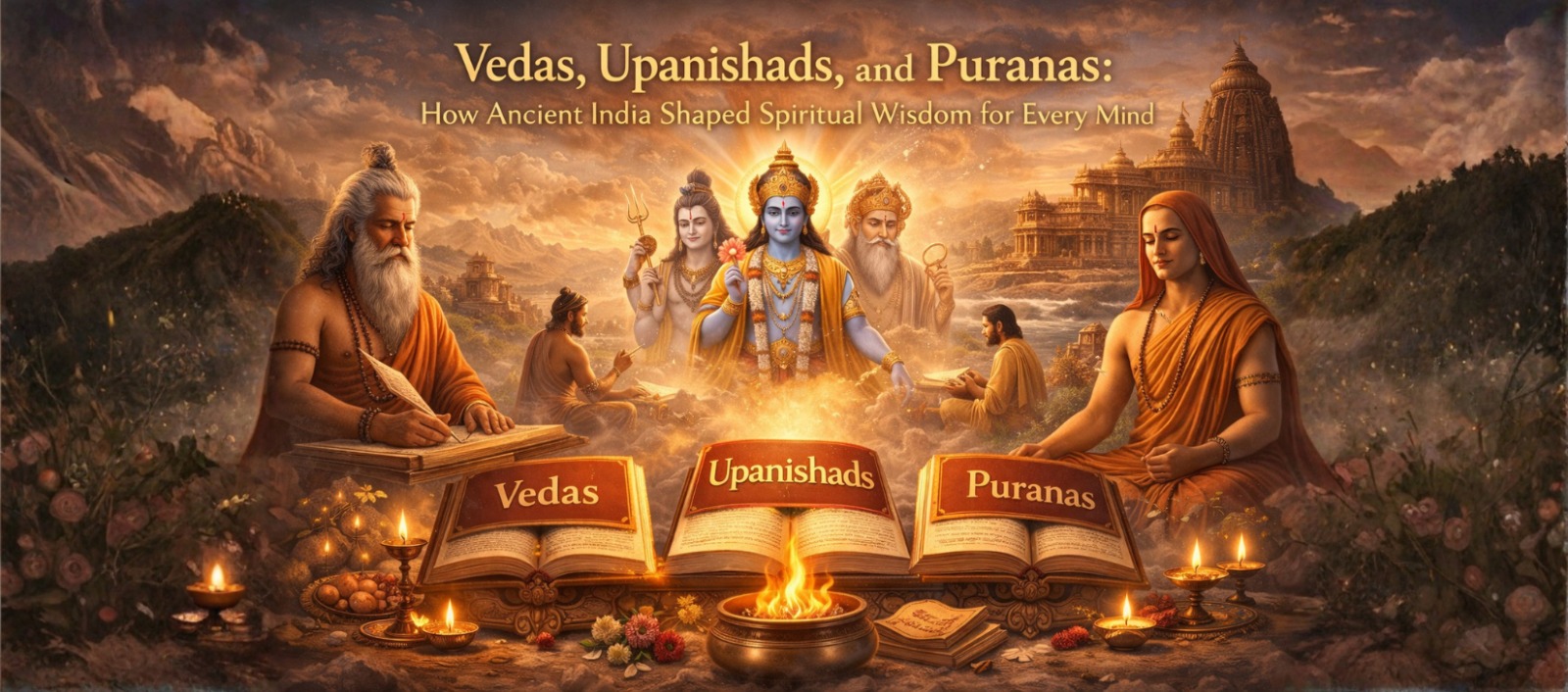
This understanding gave rise to three foundational pillars of Indian spiritual tradition: the Vedas, the Upanishads and the Puranas. Together, they form a complete spiritual ecosystem—from ritual and discipline, to philosophical inquiry and finally to devotion and storytelling. Each exists not to replace the other, but to complete the journey of understanding.
The Vedas: The Foundation of Sacred Knowledge and Action
The Vedas are the oldest surviving spiritual texts of India, composed around 1500 BCE. They are not philosophical treatises in the modern sense. They are manuals of cosmic order, ritual precision and disciplined living. The word Veda itself means “knowledge,” but this knowledge is not abstract. It is lived, practiced and enacted through rituals.
The Vedas focus largely on Karma Kanda, the path of action. They guide humans on how to live in harmony with natural forces, cosmic rhythms and divine principles. Fire rituals, hymns, mantras and sacrifices were not blind practices. They were symbolic acts meant to align human life with universal order, known as Rta.
However, the language of the Vedas is complex, symbolic and layered. It demands years of disciplined study under a teacher. Over time, it became clear that while the Vedas were profound, they were not easily accessible to everyone.
This limitation was not a flaw—it was an invitation for evolution.
The Upanishads: When Questions Replaced Rituals
As human consciousness evolved, so did its questions. People began asking not only how to perform rituals, but why they mattered. What is the self? What is death? What remains when rituals end?
From this inner inquiry arose the Upanishads, the philosophical essence of the Vedas. If the Vedas are the body, the Upanishads are the soul. They form the Jnana Kanda, the path of knowledge.
The Upanishads shift the focus from external rituals to inner realization. They speak of Atman (the inner self) and Brahman (the ultimate reality) and boldly declare that they are one and the same. This was revolutionary. Spiritual truth was no longer confined to rituals or priests; it was located within the seeker.
Yet the Upanishads are subtle, contemplative and often paradoxical. Their language is poetic, indirect and deeply symbolic. They are meant for those who are ready to sit in silence and reflect. For the common person, engaged in daily survival and emotion, this level of abstraction could feel distant.
Again, the tradition responded—not by diluting truth, but by changing its form.
The Puranas: When Wisdom Became Stories
The Puranas emerged as a compassionate response to the needs of the masses. The sages recognized that not everyone could study Vedic rituals or contemplate Upanishadic philosophy. But everyone could listen, feel and relate.
The Puranas transformed abstract truths into living narratives. Concepts like karma, dharma, rebirth and liberation were no longer ideas—they became characters, events and divine stories. Gods and goddesses were not distant cosmic forces; they became parents, friends, protectors and guides.
Through stories of Vishnu’s avatars, Shiva’s transformations, and the Goddess’s compassion and fury, spiritual principles entered homes, festivals and daily life. This was the rise of Bhakti Yoga, the path of devotion.
The Puranas did not invent new truths. They translated eternal truths into emotional language. They allowed people to connect through love, fear, awe and surrender. A farmer, a child, or a householder could now access the same wisdom that once required years of study.

Why One Scripture Was Never Enough
A common misunderstanding is to see the Vedas, Upanishads, and Puranas as separate or competing traditions. In reality, they are sequential responses to human diversity.
The sages knew that no single text could serve all minds. Some people need structure and ritual. Others seek knowledge and inquiry. Many are moved by emotion and devotion. The tradition honored all three.
The Vedas established discipline.
The Upanishads revealed truth.
The Puranas spread that truth through love and story.
This layered approach ensured that spirituality did not become exclusive. It remained inclusive, adaptable and alive.
From Ritual to Realization to Relationship
Indian spiritual tradition is not linear; it is holistic. A seeker may begin with rituals, grow into inquiry and eventually rest in devotion—or follow a completely different order. The scriptures never imposed a single path.
This flexibility is why Indian spirituality has survived for thousands of years. It adapts without losing depth. It simplifies without becoming shallow. It speaks differently to different hearts.
The Vedas teach how to act.
The Upanishads teach how to know.
The Puranas teach how to love.
Together, they form a complete spiritual journey.
Why This Structure Still Matters Today
In the modern world, people often search for quick spiritual answers while feeling disconnected from tradition. Understanding the relationship between the Vedas, Upanishads and Puranas restores context.
It reminds us that spirituality is not one-size-fits-all. It is a spectrum. Some days we need discipline. Some days we need understanding. Some days we need devotion.
Indian wisdom anticipated this complexity long before modern psychology named it.
A Living Tradition, Not a Dead Archive
These texts were never meant to be museum artifacts. They were meant to be lived. Chanting, contemplation, storytelling, festivals and daily practices all arise from this triad.
When someone performs a ritual, asks a philosophical question or sings a devotional song, they are participating in the same continuum.
The genius of Indian tradition lies not in preserving words, but in preserving access.
The Vedas, Upanishads and Puranas are not three different paths. They are three doors leading to the same truth. Each door exists because human beings are different and wisdom respects that difference.
Truth does not demand uniformity. It invites understanding.
To explore more such timeless insights that connect ancient wisdom with the modern mind, stay connected with our page and keep walking this journey of understanding with us.