

Some journeys are not meant to be comfortable.
They are meant to test your courage, your patience and your faith.
The trek to Neelkanth Mahadev Temple, hidden deep inside the forests of Uttarakhand near Rishikesh, is one such path. It is not just a route to a shrine. It is a passage through silence, wilderness and the raw presence of nature where humans are visitors—not masters.
This sacred trail winds through thick jungle corridors where real wild elephants, the Gajraj, still roam freely. These are not animals behind fences. These are massive tuskers in their own territory—alert, dominant and unpredictable.
Here, devotion walks hand in hand with danger.
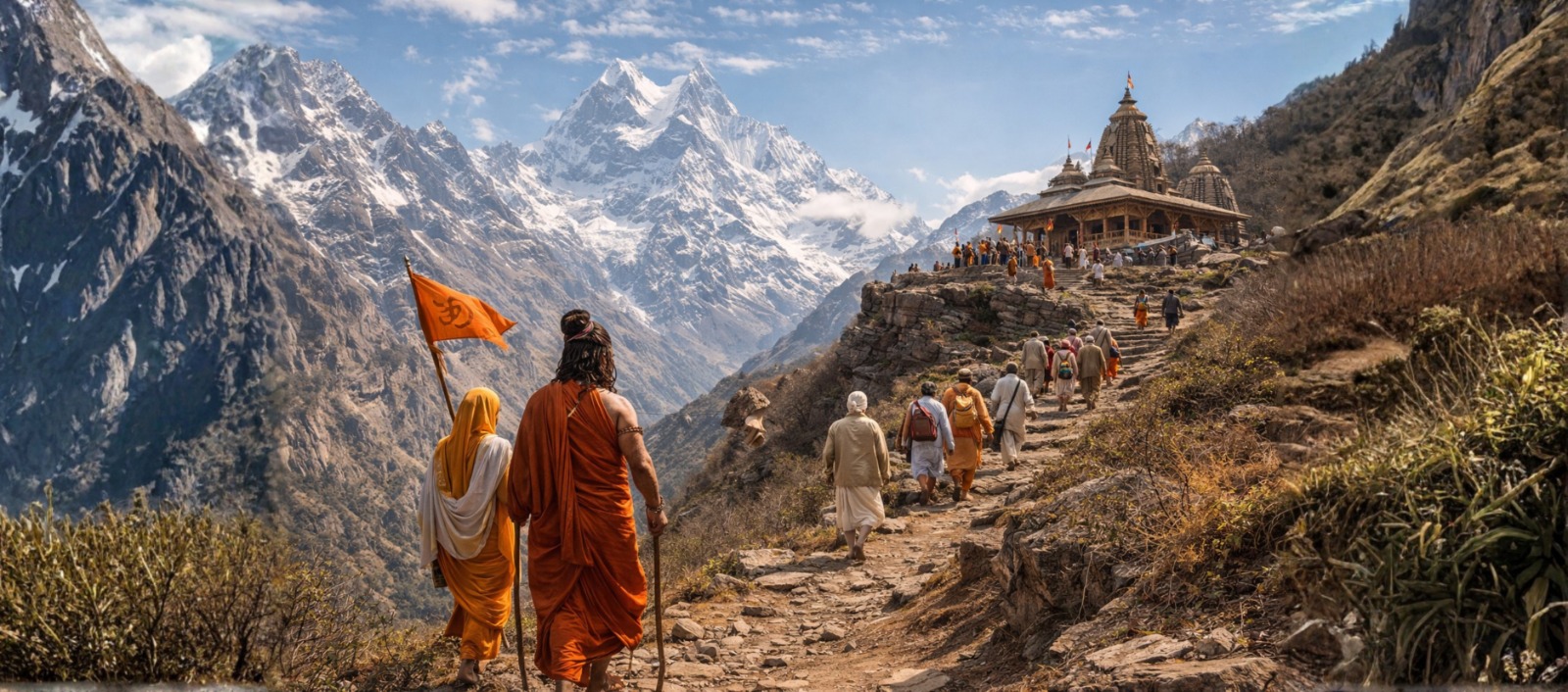
The Sacred Destination Hidden in the Forest
Neelkanth Mahadev Temple stands at an altitude of nearly 1,330 meters, surrounded by dense forested hills between the Nar and Narayan mountain ranges. It is believed to be the very place where Lord Shiva consumed the poison that emerged during the Samudra Manthan, turning his throat blue and earning the name Neelkanth.
Unlike crowded temples accessible by roads and lights, Neelkanth Mahadev still demands effort. The forest guards the shrine, almost as if nature itself decides who may reach the deity.
Many pilgrims believe that Shiva here is not a statue alone. He is present in the wind, the silence and the fear that humbles the ego.
Entering the Elephant Corridor
As the trek begins, the landscape slowly changes. Human noise fades. Mobile signals weaken. The forest thickens. Tall sal trees, moist earth and narrow trails surround you.
This region lies within an active elephant corridor.
Local villagers and forest staff warn every traveler clearly—this is gajraj territory.
Wild elephants here are not accustomed to humans. They move freely, often in herds, sometimes alone. A solitary tusker is considered the most dangerous, especially during early mornings, late evenings or the monsoon season.
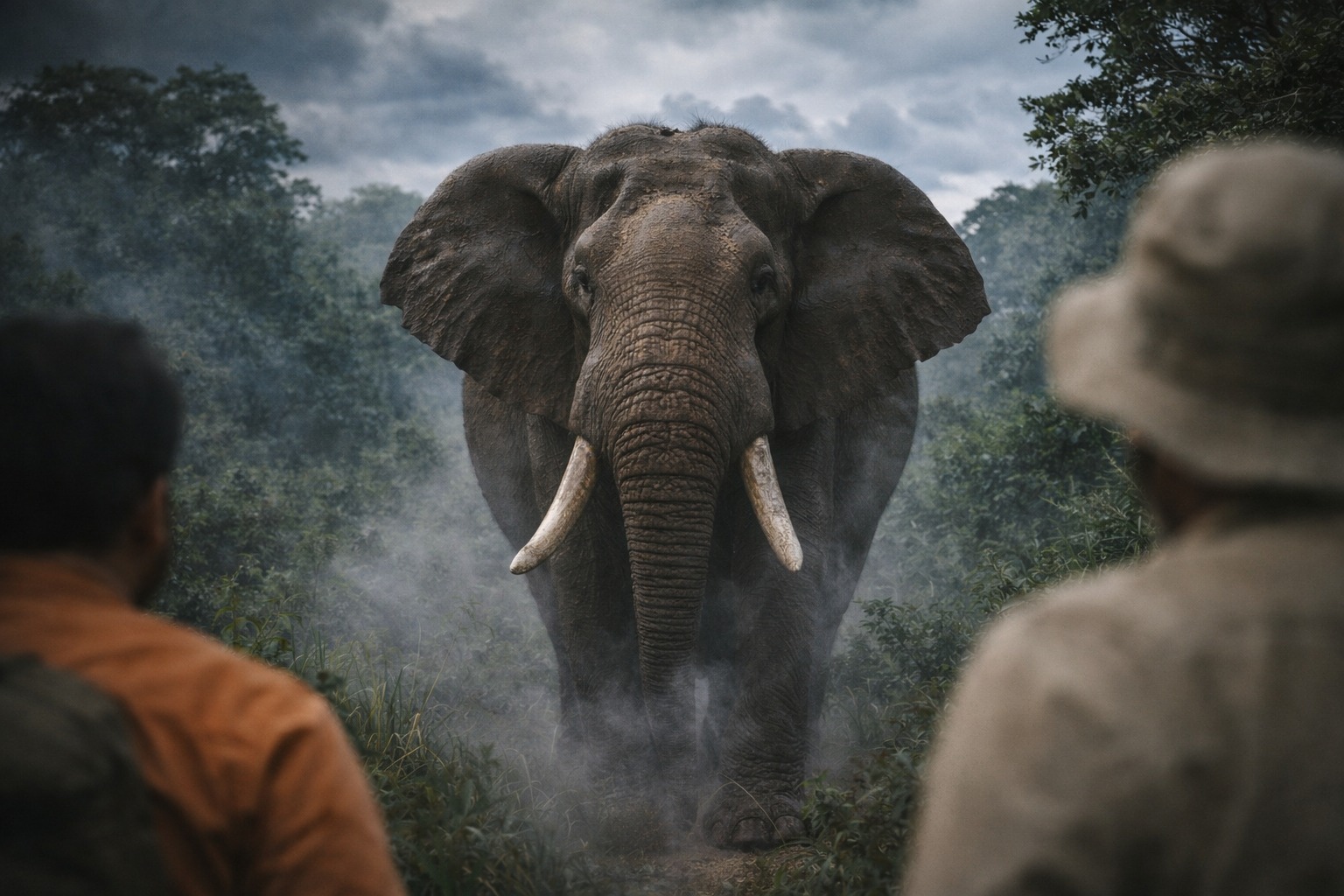
Elephants are extremely territorial. If they sense intrusion, threat or sudden movement, they do not retreat.
They charge.
The Giants of the Forest
Seeing a wild elephant here is not like spotting one in a sanctuary.
These tuskers are enormous. Their footsteps echo through the forest long before they appear. Broken branches, fresh dung, deep footprints in mud—all signs that make your heart beat faster.
Forest guides often stop suddenly, raise their hand, and whisper only one word: “Gajraj.”
At that moment, talking stops. Walking stops. Even breathing feels loud.
Because elephants do not tolerate humans inside their path. This is not fear-based myth. It is survival reality.
Many locals believe these elephants are not ordinary animals, but Shiva’s own guardians—protectors of the path.
A Trek That Demands Discipline
The Neelkanth Mahadev trek cannot be treated casually.
Pilgrims are advised to walk only during daylight. Solo trekking is strongly discouraged. Loud music, shouting, or provoking wildlife is strictly forbidden.
Here, spirituality is not about chanting loudly. It is about walking silently.
When you walk through this forest, you realize how small humans truly are. The jungle does not adjust to pilgrims. Pilgrims must adjust to the jungle.
This humility becomes part of the spiritual experience.
When Fear Turns Into Surrender
There are moments on the trail when the forest becomes unnaturally quiet. Birds stop calling. Wind slows. This silence is often the sign that a large animal is nearby.
Fear arises instantly.
But strangely, many pilgrims describe something else happening next—a deep inner calm.
They stop resisting the moment and simply surrender.
In that surrender, devotion becomes real.
Not because someone is watching, but because nature reminds you that life itself is sacred.
Many believe that those who reach Neelkanth Mahadev after passing through this forest arrive not just physically tired, but spiritually cleansed.
The Presence of Mahadev at the Peak
When the temple finally appears between the mountains, relief washes over you. The sound of bells mixes with forest air. Cold water flows from nearby springs.
The Shiva Lingam inside the temple is believed to mark the exact spot where poison fell during the cosmic churning of the ocean.
Pilgrims often say that after walking through fear, uncertainty, and danger, standing before Mahadev feels different here.
More grounded.
More silent.
More real.
This is not a place to ask loudly.
It is a place to bow quietly.
Why the Trek Is Considered Spiritually Powerful
In ancient belief, sacred places were often located deep within forests because spiritual growth required isolation, discipline, and courage.
The Neelkanth Mahadev trek continues that tradition.
The elephants, the silence, the risk—all strip away arrogance. The journey teaches respect for nature, patience with fear, and surrender to the unknown.
This is why many saints believed that true devotion is not tested in comfort, but in uncertainty.
A Reminder From the Forest
The forest around Neelkanth Mahadev does not belong to humans. We are guests. The elephants are not obstacles; they are the original inhabitants.
Respecting their space is part of respecting Shiva himself.
Those who walk with humility often return safely. Those who challenge nature invite danger.
This trek teaches a truth modern travelers often forget—faith is not proven by reaching the destination, but by how you walk the path.
The Neelkanth Mahadev trek is not just a journey to a temple. It is a walk through living wilderness where devotion meets raw reality.
Between towering trees and the footsteps of giants, one learns that spirituality does not always feel peaceful. Sometimes, it feels powerful.
And sometimes, it feels humbling enough to change you forever.
To discover more such powerful journeys, sacred paths and untold stories of India’s spiritual landscapes, follow our page and stay connected with us.