

Raksha Bandhan is more than a festival marked by a colourful thread tied around the wrist. It is a celebration of love, trust, responsibility, protection, gratitude, memories, and the emotional bond shared between siblings.
Every year, families come together on Shravana Purnima to celebrate this beautiful Indian tradition. Sisters tie a Rakhi on their brothers’ wrists, offer prayers for their happiness and wellbeing, and brothers traditionally promise to stand beside their sisters through every stage of life.
Yet the true meaning of Raksha Bandhan goes much deeper than a single ritual.
It reminds us that relationships need to be protected, respected, and nurtured.
In 2026, Raksha Bandhan will be celebrated on Friday, August 28. For families in Kolkata, the main Rakhi ceremony can be performed from 5:18 AM to 9:48 AM.
This guide explores the meaning of Raksha Bandhan, its history, traditions, legends, Rakhi Muhurat 2026, Bhadra timing, Purnima Tithi, Rakhi rituals, and the changing meaning of this timeless festival in modern life.
What Is Raksha Bandhan?
The Sanskrit expression Raksha Bandhan can broadly be understood as a “bond of protection.”
“Raksha” refers to protection or care, while “Bandhan” refers to a bond or connection.
Traditionally, a sister ties a sacred thread called a Rakhi around her brother’s wrist and prays for his wellbeing, happiness, health, and prosperity.
The brother, in return, offers a gift and expresses his commitment to support and protect his sister.
However, the emotional meaning of the festival has evolved.
Today, Raksha Bandhan is not necessarily understood as a one-sided promise in which only a brother protects a sister.
It can represent a mutual commitment:
I will stand beside you.
I will respect you.
I will support you during difficult times.
I will celebrate your happiness.
And no matter where life takes us, this bond will continue to matter.
That is what makes Raksha Bandhan timeless.
When Is Raksha Bandhan in 2026?
In 2026, Raksha Bandhan falls on Friday, August 28, 2026.
The festival is traditionally observed on Shravana Purnima, the full-moon day of the Hindu month of Shravana.
For 2026, the Purnima Tithi spans August 27 and August 28, which is why some people may initially see both dates mentioned.
However, the festival is observed on August 28, 2026, when Purnima is present at sunrise.
Raksha Bandhan 2026 Date
Date: Friday, August 28, 2026
Festival: Raksha Bandhan / Rakhi
Lunar occasion: Shravana Purnima
Raksha Bandhan 2026 Rakhi Tying Time in Kolkata
For Kolkata, the auspicious window for performing the Raksha Bandhan thread ceremony is:
Rakhi Tying Muhurat: 5:18 AM to 9:48 AM
Duration: 4 hours 30 minutes
This timing is specifically calculated for Kolkata.
Therefore, families in Kolkata who follow traditional Panchang timings should ideally complete the Rakhi ceremony during this morning period.
Purnima Tithi Timing for Raksha Bandhan 2026
Raksha Bandhan is associated with the full-moon day of the Shravana month.
For 2026:
Purnima Tithi Begins: 9:08 AM on August 27, 2026
Purnima Tithi Ends: 9:48 AM on August 28, 2026
Because Purnima continues through sunrise on August 28, Raksha Bandhan is celebrated on that day.
What About Bhadra on Raksha Bandhan 2026?
One of the most common questions every year is:
Can Rakhi be tied during Bhadra?
Traditional Hindu Panchang practice generally advises avoiding the main Raksha Bandhan ceremony during Bhadra Kaal.
In 2026, however, there is good news for families celebrating on August 28.
For Kolkata, Bhadra gets over before sunrise on August 28, meaning the morning Raksha Bandhan ceremony is free from Bhadra.
Other contemporary Panchang reporting places the Bhadra period on August 27, ending before the festival morning.
Therefore, families following the Kolkata Panchang can perform the Rakhi ceremony comfortably during the 5:18 AM to 9:48 AM window on August 28.
Why Is Rakhi Traditionally Avoided During Bhadra?
In Hindu Panchang tradition, Bhadra is associated with Vishti Karana, a period considered unsuitable for certain auspicious ceremonies.
For this reason, families who closely follow traditional Muhurat calculations usually avoid tying Rakhi while Bhadra is active.
This explains why simply knowing the festival date is not always enough.
Three factors are commonly checked:
Purnima Tithi
Bhadra period
Local Raksha Bandhan Muhurat
Since Panchang calculations may vary by geographical location, local timings should always be considered.
What Is the Best Time to Tie Rakhi in Kolkata in 2026?
For Kolkata, the clearest recommended period is:
Friday, August 28, 2026
5:18 AM to 9:48 AM
This is the main Raksha Bandhan thread-ceremony period for the city.
If your family follows strict religious timings, completing the ceremony within this window is the safest approach.
Why Is Raksha Bandhan Celebrated?
Raksha Bandhan celebrates a relationship built on affection and responsibility.
The festival is traditionally associated with brothers and sisters, but its underlying message is universal.
It reminds us that love is not only expressed through words.
Love also means:
Being present when someone needs you.
Protecting someone’s dignity.
Supporting their dreams.
Respecting their independence.
Celebrating their achievements.
Forgiving old disagreements.
And remaining emotionally connected even when distance separates you.
A Rakhi may be small, but the emotion attached to it can carry decades of shared memories.
The Spiritual Meaning of Raksha Bandhan
From a spiritual perspective, Raksha Bandhan can be understood as a reminder that meaningful relationships require both affection and responsibility.
The sacred thread symbolises more than physical protection.
It can represent:
- Emotional support
- Loyalty
- Mutual respect
- Trust
- Good wishes
- Responsibility
- Compassion
- Family unity
The ritual becomes meaningful because an intention is attached to it.
A sister ties the thread with a prayer.
A brother accepts it with affection and responsibility.
That exchange gives the Rakhi its emotional significance.
The Story of Krishna and Draupadi
One of the most popular stories associated with the spirit of Raksha Bandhan comes from the relationship between Lord Krishna and Draupadi.
According to a widely told tradition, when Krishna injured his finger, Draupadi tore a piece of cloth from her garment and wrapped it around the wound.
Touched by her spontaneous affection and concern, Krishna promised to protect her.
Later traditions connect this story with Krishna’s protection of Draupadi during a moment of great humiliation.
Whether understood literally, symbolically, or devotionally, the story captures an important message:
A bond of protection can begin not through obligation, but through genuine care.
Indra and Indrani: An Ancient Raksha Tradition
Another tradition associated with Raksha Bandhan appears in stories involving Indra and his wife Indrani, also known as Shachi.
In the narrative, a sacred protective thread is prepared and tied to Indra before battle.
This story is important because it suggests that the idea of Raksha Sutra, or a sacred thread of protection, extends beyond the modern brother-sister interpretation of Raksha Bandhan.
The thread represents blessing, prayer, courage, and protection.
Drik Panchang also identifies Indra and Indrani among the mythological figures traditionally associated with Raksha Bandhan.
Raksha Bandhan and the Mahabharata Tradition
Raksha Bandhan is closely connected with several stories in Indian cultural memory.
References surrounding Draupadi, Krishna, Yudhishthira, and protective sacred threads have all become part of popular Raksha Bandhan traditions.
Over centuries, these stories have helped shape the festival into a celebration of:
Protection without domination.
Care without conditions.
Love without distance.
How Is Raksha Bandhan Celebrated?
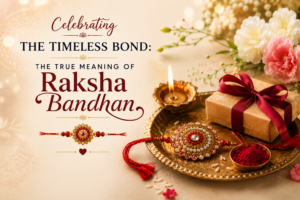
Celebrations vary from one family to another, but a traditional Raksha Bandhan ceremony often begins with preparing a Rakhi Thali.
The thali may include:
- Rakhi
- Kumkum or Roli
- Rice or Akshat
- Diya
- Sweets
- Flowers
The sister and brother then sit together for the ceremony.
Traditional Rakhi Ceremony: Step by Step
1. Prepare the Rakhi Thali
Arrange the Rakhi, Roli or Kumkum, rice grains, sweets, and a Diya on a clean plate.
Depending on family tradition, additional puja items may also be included.
2. Offer a Prayer
Some families begin by praying to their family deity or performing a short puja.
The intention is to begin the ceremony with gratitude and blessings.
3. Apply Tilak
The sister applies Roli or Kumkum Tilak to her brother’s forehead.
Rice grains may then be placed over the Tilak.
4. Perform Aarti
The sister may perform Aarti for her brother and pray for his health, happiness, success, and long life.
5. Tie the Rakhi
The Rakhi is traditionally tied around the brother’s wrist.
This is the central ritual of Raksha Bandhan.
6. Offer Sweets
The sister offers sweets to her brother.
The brother may then offer sweets to his sister as well.
7. Exchange Gifts and Blessings
Traditionally, the brother gives his sister a gift.
In many modern families, siblings exchange gifts with each other.
The gift itself is secondary.
The real value lies in the affection behind it.
Which Hand Should Rakhi Be Tied On?
Traditionally, Rakhi is tied on the right wrist.
Many Hindu rituals treat the right hand as significant for sacred actions and ceremonies.
However, regional and family customs may differ.
The emotion behind the ritual remains more important than rigidly following every minor variation.
What Should Be Included in a Rakhi Thali?
A simple traditional Rakhi Thali may contain:
Rakhi: The sacred thread.
Roli or Kumkum: Used for Tilak.
Akshat or Rice: Traditionally placed with the Tilak.
Diya: Used during Aarti.
Sweets: Shared after the ceremony.
Flowers: Optional offerings.
Some households may also include sandalwood, coconut, dry fruits, or additional puja items according to family tradition.
Why Do Sisters Tie Rakhi?
Traditionally, sisters tie Rakhi while praying for their brothers’ health, prosperity, happiness, and long life.
But the ritual should not be understood as suggesting that women need protection because they are weak.
Modern families increasingly interpret the bond as mutual.
A sister may protect her brother emotionally.
A brother may encourage his sister professionally.
One sibling may support the other financially during difficult times.
Another may simply be the person who answers the phone at 2 AM.
Protection has many forms.
The Role of the Brother on Raksha Bandhan
Traditionally, brothers make a promise to protect their sisters and offer gifts after the Rakhi ceremony.
Today, that promise can be understood more broadly.
Supporting a sister may mean:
Respecting her decisions.
Supporting her education.
Encouraging her career.
Standing against injustice.
Respecting her boundaries.
Being emotionally available.
Celebrating her independence.
True protection should never mean controlling someone’s life.
It should mean helping them feel secure enough to live it freely.
Raksha Bandhan Is Not Only About Brothers and Sisters
Over time, Rakhi has become a symbol that can extend beyond biological siblings.
Rakhis may also be exchanged between:
- Cousins
- Close family friends
- Sisters
- Brothers
- Members of extended families
- People who share a relationship of trust and protection
The deeper principle is Raksha—the promise of care.
This allows the tradition to retain its ancient roots while remaining emotionally meaningful in contemporary society.
Raksha Bandhan Between Sisters
In many families today, sisters tie Rakhi to each other.
This reflects the simple truth that sisters can also protect, support, guide, and strengthen one another.
A sibling bond does not need to fit into a rigid definition.
The heart of Raksha Bandhan lies in mutual love and responsibility.
Celebrating Raksha Bandhan When Your Sibling Lives Far Away
Modern families often live across different cities, countries, and time zones.
One sibling may be in Kolkata.
Another may be in Bengaluru.
Another may be in London, Dubai, Toronto, Singapore, or New York.
Distance changes the ceremony, but it does not have to weaken the bond.
Families celebrate long-distance Raksha Bandhan by:
- Sending Rakhi by courier
- Ordering Rakhi online
- Scheduling a video call
- Sending handwritten letters
- Sharing childhood photographs
- Sending sweets and gifts
- Performing the ceremony virtually
Sometimes a five-minute video call can carry the warmth of an entire childhood.
The Emotional Meaning of Rakhi in Modern Life
Childhood sibling relationships are rarely perfect.
Brothers and sisters argue.
They compete.
They complain about each other.
They borrow things without asking.
They know exactly how to irritate one another.
Then life changes.
School ends.
Careers begin.
Marriage happens.
Cities change.
Parents grow older.
And suddenly the person you once fought with over a television remote becomes one of the few people who remembers almost every version of you.
That is why Raksha Bandhan becomes more meaningful with age.
It reconnects siblings not only with one another, but with their shared past.
Raksha Bandhan and Childhood Memories
Ask someone what they remember most about Raksha Bandhan, and the answer may not be the most expensive gift they received.
They may remember:
Travelling to a grandparent’s house.
Choosing Rakhis from a crowded market.
Homemade sweets.
A sibling hiding because they did not want Tilak applied.
Family photographs.
Coins given as childhood gifts.
Parents smiling while everyone argued about who got the bigger sweet.
Festivals become meaningful because they preserve memories.
Raksha Bandhan is one of those traditions that allows childhood to return for a few hours every year.
Raksha Bandhan Across India
Raksha Bandhan is celebrated widely across India, though regional traditions and accompanying observances may vary.
The festival falls on Shravana Purnima, a day associated with several cultural and religious observances.
In different communities, the day may also be connected with traditions such as:
- Narali Purnima
- Shravani or Upakarma observances
- Sacred-thread ceremonies
- Local community rituals
This diversity demonstrates how one lunar date can carry different cultural meanings across India.
Raksha Bandhan and Indian Culture
Indian festivals often preserve relationships through ritual.
Diwali brings families together.
Holi celebrates community and joy.
Bhai Dooj honours sibling affection.
Raksha Bandhan creates a dedicated moment to acknowledge the relationship between brothers and sisters.
In everyday life, affection often remains unspoken.
We assume the people closest to us already know how we feel.
Festivals create a reason to say it.
That may be one of Raksha Bandhan’s greatest strengths.
Rakhi Is a Promise, Not Just a Thread
A Rakhi may be made of silk, cotton, beads, silver, decorative stones, or even simple handmade thread.
Its material value does not determine its meaning.
A simple thread tied with love may carry far greater emotional value than an expensive designer Rakhi.
The power of Rakhi lies in what it represents:
“You matter to me.”
“Your happiness matters to me.”
“Your struggles are not yours alone.”
“Wherever life takes us, our bond remains.”
Eco-Friendly Raksha Bandhan Ideas
Families increasingly want festivals to remain meaningful while reducing unnecessary waste.
Some eco-conscious Rakhi ideas include:
- Handmade cotton Rakhis
- Seed Rakhis
- Natural-fibre Rakhis
- Reusable Rakhis
- Locally crafted Rakhis
- Minimal packaging
- Homemade sweets
- Experience-based gifts instead of excessive packaging
The goal does not have to be perfection.
Even one thoughtful change can make a celebration more sustainable.
Meaningful Raksha Bandhan Gift Ideas
Raksha Bandhan gifts do not have to be expensive.
A meaningful gift is one that reflects the recipient.
Ideas include:
- Books
- Handmade letters
- Personalised photo albums
- Jewellery
- Clothing
- Plants
- Travel experiences
- Hobby-related gifts
- Wellness experiences
- Handmade products
- A shared meal
- A family trip
Sometimes the most valuable gift is time.
Taking one day away from busy schedules to sit together can become more memorable than anything purchased online.
Raksha Bandhan for Children
Raksha Bandhan offers parents an opportunity to teach children about relationships.
Instead of telling a young boy only that he must “protect his sister,” parents can explain a more balanced message:
Respect one another.
Stand up for one another.
Be kind.
Share.
Apologise when you are wrong.
Celebrate each other’s success.
Help each other when life becomes difficult.
This interpretation preserves tradition while giving it a healthier contemporary meaning.
Lessons Raksha Bandhan Teaches Us
The festival carries several lessons that extend far beyond one day.
Relationships Need Effort
Family bonds may be natural, but healthy relationships still require communication and care.
Protection Should Be Mutual
Both siblings can support one another.
Respect Is Essential
Love without respect cannot create a healthy relationship.
Distance Does Not End Connection
People can remain emotionally close even when they live thousands of kilometres apart.
Small Traditions Preserve Memories
A thread, a Tilak, a sweet, and a family photograph may become treasured memories years later.
Gratitude Should Be Expressed
We often realise someone’s importance only after circumstances change.
Festivals remind us to appreciate people while they are present.
Will there be Bhadra during the Rakhi ceremony on August 28?
For Kolkata, Drik Panchang states that Bhadra ends before sunrise so it does not affect the recommended morning Rakhi ceremony.
Can Rakhi be tied after 9:48 AM?
Families who strictly follow the Purnima-based Raksha Bandhan Muhurat should ideally complete the principal Rakhi ceremony before 9:48 AM, because Purnima Tithi ends at that time.
Family customs and regional traditions can vary, so households following a specific priest or Panchang tradition may follow their customary guidance.
Which hand is Rakhi traditionally tied on?
Rakhi is traditionally tied on the brother’s right wrist.
What does Raksha Bandhan symbolise?
Raksha Bandhan symbolises love, protection, trust, responsibility, respect, and the enduring bond between siblings.
Raksha Bandhan 2026 at a Glance
For readers in Kolkata, the most important details are:
Raksha Bandhan Date: Friday, August 28, 2026
Rakhi Muhurat in Kolkata: 5:18 AM – 9:48 AM
Purnima Begins: August 27 at 9:08 AM
Purnima Ends: August 28 at 9:48 AM
Bhadra: Ends before sunrise on August 28 in Kolkata
Best approach: Perform the principal Rakhi ceremony during the morning Muhurat before 9:48 AM.
The True Meaning of Raksha Bandhan
Traditions survive because every generation discovers a new meaning within them.
The Rakhi once tied during childhood changes meaning as siblings grow older.
As children, it may mean sweets and gifts.
As teenagers, it may mean teasing and photographs.
As adults, it may become a reminder to call one another more often.
And as families grow older, the thread may represent something even deeper:
Shared memories.
Parents.
Home.
Childhood.
Support.
And the comforting knowledge that somewhere in the world there is someone who has known you for almost your entire life.
That is why Raksha Bandhan remains timeless.
It is not merely a ritual of protection.
It is a celebration of belonging.
Celebrate the Timeless Bond This Raksha Bandhan
This Raksha Bandhan, go beyond simply tying a thread.
Take a moment to appreciate the person behind the relationship.
Remember the childhood memories.
Let go of an old disagreement.
Make the phone call you have been postponing.
Sit together without looking at your phones.
Share a meal.
Take a family photograph.
And tell your sibling what you may not say often enough:
“No matter where life takes us, this bond will always matter.”
Celebrate India’s Traditions, Stories and Timeless Connections
At Explore Indian Trails, we celebrate the traditions, spiritual stories, cultural heritage, destinations, and experiences that make India extraordinary.
Discover more meaningful stories about Indian festivals, traditions, spirituality, culture, travel, and heritage with us.
Contact Explore Indian Trails today