
Navratri is one of India’s most vibrant and spiritually significant festivals, bringing together devotion, fasting, music, dance, colourful traditions and regional celebrations. Dedicated to Goddess Durga and her nine divine forms, the festival is observed for nine sacred nights and celebrates the triumph of positive energy over negativity.
In 2026, Shardiya Navratri will begin on Sunday, October 11, 2026. The celebrations progress through the worship of the nine forms of Goddess Durga and culminate with Vijayadashami, or Dussehra, on Tuesday, October 20, 2026.
For travellers, Navratri is also an extraordinary opportunity to experience India’s cultural diversity. From energetic Garba nights in Gujarat to elaborate Durga celebrations in eastern India and deeply devotional temple rituals across the country, every region gives the festival its own distinctive character.
If you are planning to experience Navratri in India, this complete Navratri 2026 guide covers the important dates, Ghatasthapana muhurat, nine forms of Goddess Durga, rituals, fasting traditions and some of the best ways to experience the festival while travelling.
When Is Navratri 2026?
Shardiya Navratri 2026 begins on October 11, 2026, with Ghatasthapana and Shailputri Puja.
The festival continues through the worship of the Navadurga and concludes with Navratri Parana, Durga Visarjan and Vijayadashami on October 20, 2026.
Navratri 2026 Important Dates
| Occasion | Date | Day |
|---|---|---|
| Navratri Begins / Ghatasthapana | October 11, 2026 | Sunday |
| Shailputri Puja | October 11, 2026 | Sunday |
| Brahmacharini Puja | October 12, 2026 | Monday |
| Chandraghanta Puja | October 13, 2026 | Tuesday |
| Kushmanda Puja | October 14, 2026 | Wednesday |
| Skandamata Puja | October 15, 2026 | Thursday |
| Katyayani Puja | October 16, 2026 | Friday |
| Kalaratri-related Navratri observances progress through the later festival days | October 17–18, 2026 | Saturday–Sunday |
| Durga Ashtami / Mahagauri Puja | October 19, 2026 | Monday |
| Maha Navami / concluding rituals | October 19–20, 2026 | Monday–Tuesday |
| Vijayadashami / Dussehra | October 20, 2026 | Tuesday |
Traditional Panchang observances can differ slightly by location because Hindu festival timings are determined according to local sunrise and tithi calculations. Travellers should therefore check the Panchang for the city where they plan to perform the puja.
Navratri 2026 Ghatasthapana Muhurat
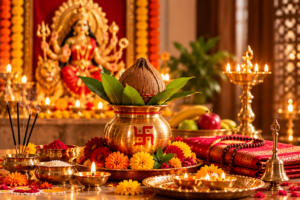
Ghatasthapana, also known as Kalash Sthapana, is one of the most important ceremonies performed at the beginning of Shardiya Navratri. It symbolically invokes Goddess Shakti and marks the beginning of the nine-day period of worship.
For Delhi, India, Drik Panchang lists the 2026 Ghatasthapana details as:
Date: Sunday, October 11, 2026
Ghatasthapana Muhurat: 6:19 AM to 10:12 AM
Duration: 3 hours 52 minutes
Abhijit Muhurat: 11:44 AM to 12:31 PM
Pratipada Tithi begins on the evening of October 10 and ends on October 11.
These timings are location-specific. For example, Bengaluru has a slightly different Ghatasthapana window, demonstrating why devotees should confirm the muhurat according to their own city.
What Is Shardiya Navratri?
Navratri literally means “nine nights.” Although different Navratris are observed throughout the Hindu calendar, Shardiya Navratri is among the most widely celebrated.
It takes place during the Hindu lunar month of Ashwin and is devoted to Goddess Durga, representing divine feminine energy or Shakti.
During these sacred days, devotees worship nine manifestations of the Goddess, collectively known as Navadurga.
The festival represents courage, wisdom, spiritual discipline, purity and the victory of good over evil. Homes and temples are decorated, lamps are lit, devotional songs are performed and millions of devotees observe fasting or follow a sattvic diet.
Yet Navratri is much more than a religious festival. It is also a remarkable cultural experience in which dance, traditional clothing, food, music, community gatherings and regional customs come together.
Navratri 2026: Nine Days and Nine Forms of Goddess Durga
Each day of Navratri is traditionally dedicated to a different form of Goddess Durga. Every manifestation represents a particular quality, spiritual lesson and aspect of divine feminine power.
Day 1 – Maa Shailputri
Navratri begins with the worship of Maa Shailputri, regarded as the daughter of the mountains.
She represents strength, stability and purity.
Devotees begin their Navratri worship with Ghatasthapana and prayers seeking a strong and positive beginning to the festival.
October 11, 2026 is listed as the first day of Navratri, with Ghatasthapana and Shailputri Puja.
Day 2 – Maa Brahmacharini
The second day is dedicated to Maa Brahmacharini, a form associated with devotion, patience, spiritual discipline and determination.
Devotees pray for inner strength, wisdom and the ability to remain committed to their goals.
Brahmacharini Puja falls on October 12, 2026.
Day 3 – Maa Chandraghanta
The third day honours Maa Chandraghanta.
This powerful form represents courage and protection while also symbolising peace and grace.
Her worship reminds devotees to face difficulties with confidence while maintaining inner balance.
Chandraghanta Puja is observed on October 13, 2026.
Day 4 – Maa Kushmanda
The fourth manifestation is Maa Kushmanda, traditionally associated with creative energy, light and vitality.
Devotees worship her seeking good health, positivity and prosperity.
Kushmanda Puja falls on October 14, 2026.
Day 5 – Maa Skandamata
The fifth day is dedicated to Maa Skandamata, the mother of Lord Kartikeya or Skanda.
She represents maternal compassion, protection and unconditional love.
Her worship is associated with peace, wisdom and blessings for the family.
Day 6 – Maa Katyayani
Maa Katyayani is worshipped during the sixth stage of Navratri.
She represents strength and the courage required to overcome injustice and adversity.
Her form reflects the powerful protective aspect of Goddess Durga.
Day 7 – Maa Kalaratri
The seventh form, Maa Kalaratri, represents fearlessness and the destruction of negative forces.
Although her appearance is traditionally described as fierce, she is worshipped as a compassionate protector who removes fear, darkness and obstacles.
Day 8 – Maa Mahagauri
Maa Mahagauri represents purity, serenity and spiritual transformation.
The later days of Navratri are especially important in many parts of India, with Durga Ashtami ceremonies, special prayers and Kanya Puja commonly observed.
In the 2026 calendar, Durga Ashtami and Mahagauri Puja are listed on October 19.
Day 9 – Maa Siddhidatri
The final form of Navadurga is Maa Siddhidatri.
She represents fulfilment, spiritual wisdom and divine blessings.
The concluding Navratri rituals lead into Maha Navami, Durga Visarjan and eventually Vijayadashami, depending on local traditions and tithi timings.
How Is Navratri Celebrated?
Navratri celebrations vary dramatically from one region of India to another, making it one of the most fascinating festivals for cultural travellers.
Some devotees spend the festival in prayer and fasting, while others participate in enormous community gatherings filled with dance and music.
Ghatasthapana or Kalash Sthapana
Navratri begins with Ghatasthapana.
A sacred Kalash is established in the puja area and worship begins with prayers to Goddess Durga. Depending on regional and family traditions, devotees may also sow barley or grains beside the Kalash.
The ritual marks the formal beginning of Navratri worship.
Daily Durga Puja
Devotees worship a different form of Goddess Durga each day.
A typical household puja may include lighting a diya, offering flowers and fruits, reciting mantras, reading religious texts and performing an aarti.
Navratri Fasting
Fasting is an important practice for many devotees during Navratri.
Some people observe a fast on all nine days, while others fast only on selected days such as the first and last days.
Regular grains are often avoided, while foods prepared using ingredients such as fruits, milk, potatoes, sabudana, kuttu and singhara may be consumed according to family customs.
Fasting traditions vary, so there is no single practice followed by everyone.
Kanya Puja
Kanya Puja, or Kumari Puja, is commonly performed during Ashtami or Navami.
Young girls are ceremonially worshipped as representations of divine feminine energy and are traditionally offered food, gifts and blessings.
Garba and Dandiya Raas
In Gujarat and many other parts of India, Navratri evenings transform into colourful celebrations of Garba and Dandiya Raas.
People dressed in vibrant traditional attire gather in circles, dance to folk and devotional music and celebrate until late in the evening.
For visitors interested in Indian festivals, these gatherings can offer an unforgettable combination of tradition, community and celebration.
Navratri Celebrations Across India
One of the most fascinating aspects of travelling in India during Navratri is seeing how differently the same festival is celebrated across regions.
Gujarat – The Land of Garba
Gujarat is one of the most famous destinations for Navratri celebrations.
Cities such as Ahmedabad and Vadodara become centres of Garba and Dandiya celebrations, with participants wearing colourful chaniya cholis, kediyus and other traditional garments.
For travellers who want to experience the energetic and social side of Navratri, Gujarat offers an extraordinary atmosphere.
West Bengal – Durga Puja Celebrations
In West Bengal, particularly Kolkata, the festive period becomes synonymous with magnificent Durga Puja celebrations.
Elaborately designed pandals, artistic idols, lights, cultural programmes and traditional food transform the city into a giant cultural exhibition.
Although Durga Puja has its own distinctive ritual calendar and traditions, it overlaps with the sacred festive period associated with Goddess Durga.
North India – Devotion, Ramleela and Dussehra
Across many parts of northern India, Navratri is closely associated with fasting, temple visits and performances of the Ramleela.
The festive period culminates in Vijayadashami or Dussehra, symbolising the victory of good over evil.
Himachal Pradesh
Navratri celebrations in Himachal Pradesh have a deeply devotional atmosphere, particularly around important Devi temples.
Travellers often combine pilgrimage with journeys through the Himalayan landscape, creating a blend of spirituality and exploration.
Jammu
The Navratri period is especially significant for pilgrims travelling to the revered Mata Vaishno Devi shrine.
The journey attracts devotees from across India and offers one of the country’s best-known pilgrimage experiences.
Karnataka
In Karnataka, the festival is closely associated with the famous Mysuru Dasara celebrations.
The city becomes known for illuminated landmarks, cultural performances and elaborate festivities surrounding Vijayadashami.
Why Navratri Is a Special Time to Travel in India
India is colourful throughout the year, but festivals allow travellers to experience the country beyond monuments and sightseeing.
Navratri gives visitors an opportunity to observe living traditions that have been passed down across generations.
You may begin your evening watching an aarti at a temple, walk through beautifully decorated streets, join a Garba celebration, explore Durga Puja pandals or taste regional festive dishes.
Every destination offers a different experience.
For photographers, Navratri presents vivid traditional clothing, illuminated temples, decorated streets and energetic cultural performances.
For cultural travellers, it provides an opportunity to understand Indian traditions more closely.
For spiritual travellers, the nine sacred days offer temple visits, pilgrimage experiences and a peaceful environment for reflection.
Tips for Travelling During Navratri 2026
Navratri attracts large crowds, especially in destinations famous for Garba, Durga Puja, temples and Dussehra celebrations. A little advance planning can make your journey much more comfortable.
Book Your Travel Early
Popular flights, trains and hotels can become busy around major festivals.
If you are planning to visit destinations such as Gujarat, Kolkata, Mysuru or major pilgrimage centres, consider arranging accommodation and transport well in advance.
Carry Comfortable Footwear
Festival exploration can involve considerable walking, particularly while visiting temples, pandals or large Garba grounds.
Comfortable footwear can make a significant difference.
Remember that footwear generally needs to be removed before entering temples and certain religious spaces.
Respect Local Customs
India’s festivals are both celebrations and religious observances.
Dress appropriately when visiting temples, follow photography restrictions and respect queues and local instructions.
Check Local Event Timings
Garba events, temple ceremonies, Durga Puja rituals and Dussehra celebrations may have destination-specific schedules.
Check timings shortly before visiting because schedules can change.
Plan for Crowds
Popular venues can become extremely crowded during peak evening hours.
Allow additional travel time and keep essential belongings secure.
Try Regional Festival Food
Food is an important part of experiencing Indian culture.
Depending on your destination, you may encounter special fasting dishes, sweets, Gujarati snacks, Bengali festive cuisine and various local delicacies.
What Is the Significance of Vijayadashami?
Navratri concludes around the celebration of Vijayadashami, also known as Dussehra.
In different traditions, the day represents different stories connected by a common theme: the victory of righteousness over evil.
In many parts of northern India, Dussehra is associated with Lord Rama’s victory over Ravana.
In traditions centred on Goddess Durga, the festival celebrates the triumph of Goddess Durga over Mahishasura.
In 2026, Vijayadashami falls on Tuesday, October 20, according to the referenced Panchang calendar.
Frequently Asked Questions About Navratri 2026
When does Navratri 2026 start?
Shardiya Navratri 2026 begins on Sunday, October 11, 2026, with Ghatasthapana and Shailputri Puja.
When does Navratri 2026 end?
The concluding rituals, including Navratri Parana, Durga Visarjan and Vijayadashami, are listed for Tuesday, October 20, 2026.
What is the Ghatasthapana Muhurat for Navratri 2026?
For Delhi, the Ghatasthapana Muhurat is listed as 6:19 AM to 10:12 AM on October 11, 2026. An Abhijit Muhurat from 11:44 AM to 12:31 PM is also listed. Timings vary by location.
Which Goddess is worshipped on the first day of Navratri?
The first day is dedicated to Maa Shailputri, the first form of Navadurga.
How many days is Navratri celebrated?
Navratri literally refers to nine nights, during which the nine forms of Goddess Durga are traditionally worshipped. The festive calendar can extend into a tenth day with Vijayadashami.
Can tourists participate in Garba during Navratri?
Many public and organised Garba celebrations welcome visitors. Travellers should check individual event entry requirements, dress guidelines and ticket arrangements before attending.
Which places are famous for Navratri celebrations in India?
Gujarat is particularly famous for Garba and Dandiya, while Kolkata is renowned for Durga Puja celebrations. Mysuru is known for Dasara, and numerous temple and pilgrimage destinations across northern India attract devotees during Navratri.
What food is eaten during Navratri fasting?
Depending on family and regional traditions, fasting meals may include fruits, dairy products, potatoes, sabudana, kuttu flour, singhara flour and other permitted ingredients. Individual fasting practices can vary considerably.
Experience the Spirit of Navratri 2026
Navratri is not simply a festival on the Indian calendar. It is nine nights filled with faith, colour, music, dance, community and centuries-old traditions.
From the rhythmic Garba circles of Gujarat and magnificent Durga celebrations of eastern India to peaceful temple ceremonies and sacred pilgrimage routes, Navratri offers countless ways to discover the cultural and spiritual diversity of India.
Navratri 2026 begins on October 11, making it the perfect opportunity to plan a journey that goes beyond ordinary sightseeing and brings you closer to the traditions, people and stories that make India extraordinary.
Plan Your Navratri Journey with Explore Indian Trails
Want to experience the colour, devotion and cultural energy of Navratri 2026 for yourself?
Discover incredible destinations, traditional festivals, spiritual journeys and unforgettable experiences across India with Explore Indian Trails.
Whether you want to witness Garba celebrations, explore magnificent Durga Puja pandals, visit sacred temples or discover India’s festive traditions, start planning a journey filled with authentic Indian experiences.
Plan Your Navratri 2026 Journey with Explore Indian Trails Today!